Workflow Alchemy: Turning Conversations into Content Gold
Your best content is already hidden in your conversations. Here's how to build a system that transforms dialogue into polished articles.
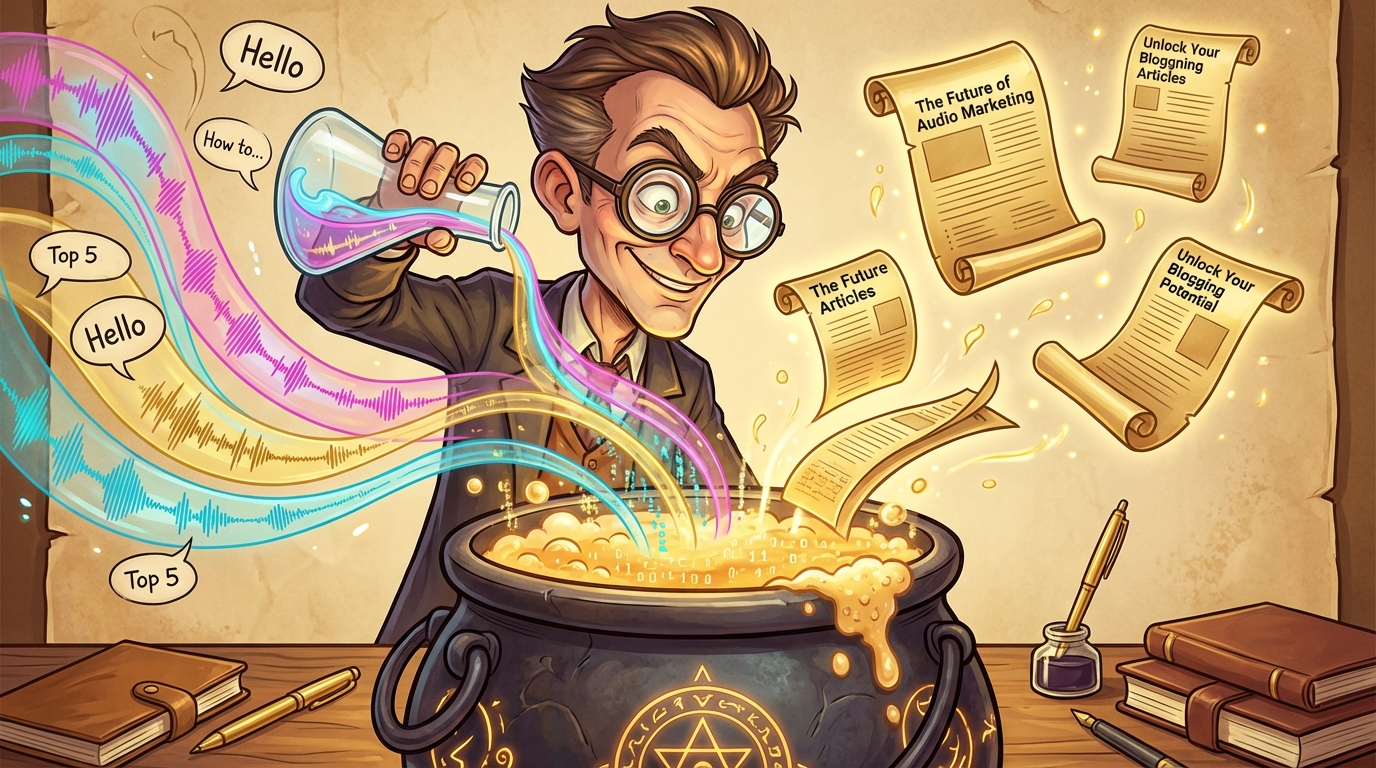
Every week, I have conversations that could be valuable content.
Client calls where I explain concepts I’ve thought about for years. Casual chats where I work through problems out loud. Discussions that surface insights I’d never think to write down.
Most of this disappears. The conversation ends, we move on, and those insights are gone.
But it doesn’t have to work that way.
The Hidden Content Goldmine
Think about your last few meaningful conversations. Maybe it was a discovery call with a potential client. Maybe it was explaining your work to a friend. Maybe it was a podcast interview or a team brainstorm.
In those conversations, you probably shared expertise, told stories, and explained concepts in ways that would resonate with your audience. You did this naturally, without the friction of staring at a blank page.
The problem is capture. Those insights lived in the moment and then vanished.
From Conversation to Content
The approach I’ve been exploring treats conversations as source material for written content.
It starts with recording. Not every conversation, but the ones where real value is being exchanged. Client calls, expert interviews, coaching sessions, strategic discussions.
Those recordings become transcripts. And those transcripts become the raw material for articles, posts, and other content.
The key insight is that speaking and writing are different skills. Many of us communicate better verbally than in writing. We’re more natural, less constrained, more willing to explore ideas out loud.
By starting with speech and transforming it into text, you capture that natural communication style.
The Automation Layer
What makes this scalable is automation. Modern AI tools can transform rough transcripts into polished drafts.
A conversation about positioning strategy becomes a blog post on competitive differentiation. A client Q&A session becomes an FAQ page. A story you told about a past project becomes a case study framework.
The AI doesn’t replace your thinking. It takes your thinking, expressed verbally, and restructures it for written consumption.
This isn’t about generating content from nothing. It’s about converting content that already exists in conversation form into content that can reach a wider audience.
Building the Workflow
Here’s what a conversation-to-content workflow might look like:
Capture. Use meeting recording tools or simple voice memos to capture conversations. The technology is trivially easy now.
Transcribe. AI transcription has gotten remarkably accurate. What took hours of manual work now happens automatically.
Extract. Review transcripts for valuable content. Not everything is worth turning into an article. But gems emerge from even short conversations.
Transform. Use AI writing tools to convert extracted insights into draft content. Set up templates for different content types.
Edit. The output needs human refinement. The AI gets structure and clarity. You add voice and nuance.
Publish. Push finished content to your blog, newsletter, or social channels.
The Quality Question
There’s a legitimate concern here about quality. Won’t content that started as conversation feel different? Won’t it lack the polish of purpose-written pieces?
The answer depends on the source material and the editing process.
Content that starts from genuine expertise, expressed naturally in conversation, often has more authenticity than content written from scratch with “optimize for engagement” in mind. The insights are real. The stories come from experience. The voice is human.
The editing step is where you ensure quality. The AI draft isn’t the final product. It’s a starting point that saves you from the blank page while preserving the substance of what you shared verbally.
Maintaining Your Voice
One risk with AI-assisted content is losing your distinctive voice. Everything can start to sound the same, polished in a generic way.
The solution is in how you set up the transformation step. Provide examples of your writing. Specify the tone you want. Create templates that match your style.
And always edit the output. The AI gives you structure. You give it personality.
When This Works Best
This approach isn’t right for every piece of content. Some things need to be written from scratch with careful intention.
But for the volume of content that modern visibility requires, especially for solopreneurs and small teams, having a system that converts conversations to content is transformative.
It means your expertise doesn’t stay locked in private discussions. It means the insights you share with one client can benefit many readers. It means the barrier between having valuable knowledge and sharing it gets much lower.
Starting Small
If this interests you, start with one conversation this week.
Record a call where you know you’ll be explaining something valuable. Get it transcribed. Read through and identify one insight that could become a standalone piece of content.
Try transforming that single insight into a draft using whatever AI tool you prefer. Edit it to match your voice. See how it feels.
You don’t need a fully automated pipeline to get value from this approach. You just need to see your conversations as content waiting to be unlocked.
The conversations you’re already having contain more value than you realize. Building a system to capture and transform that value is one of the highest-leverage moves for any content creator.
Ohad Michaeli
Strategic positioning for Shopify apps
Want more insights like this?
Join Shopify app founders who get actionable positioning and optimization strategies.