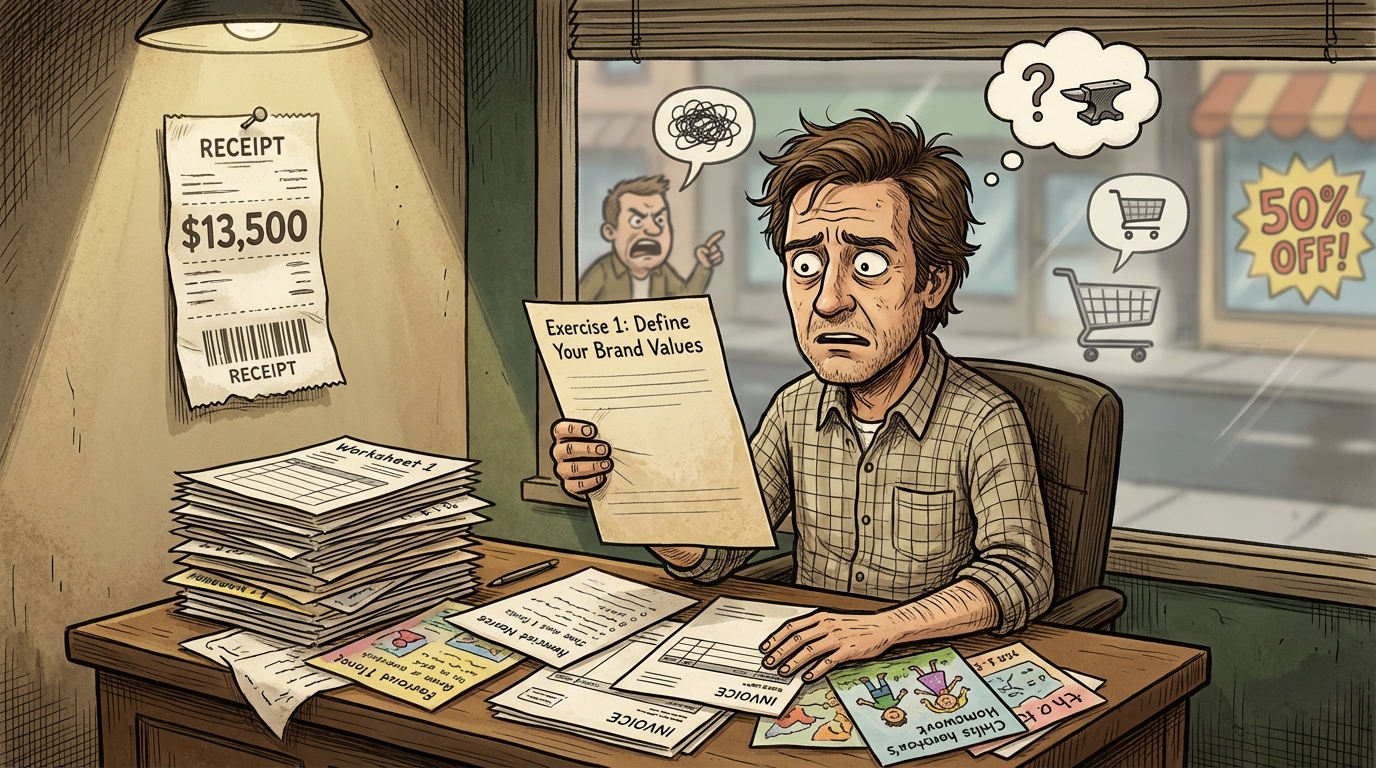
She Paid $13.5K. They Sent Homework.
Complexity kills execution. Here's why busy founders don't want advice, they want a path cleared.
TL;DR
Founders don’t pay for advice—they pay for execution. A $13.5K agency sent my friend 60-page decks instead of clearing a path. She opened zero. The gap between valuable advice and usable advice is the difference between getting paid and getting ghosted.
Who This Is For
Consultants, agency owners, and service providers who wonder why clients don’t implement their recommendations.
The Core Problem
You’re delivering value that clients can’t use. Complexity kills execution, and if your deliverable requires homework, you’ve already lost.
My friend invested $13,500 in a lead generation agency.
Six-month project. The promise was a 30% profit boost.
Then the emails started.
Fifty-page decks.
Sixty-page decks.
“Implement this.”
“Read this.”
“Understand this.”
Guess how many she opened.
Zero.
I saw them in her inbox. I didn’t want to open them either.
The Homework Problem
Not because they lacked value. Probably packed with good stuff.
But busy founders don’t want homework. They want a path cleared.
They want motion. They want from point A to point B. Fast. With the least friction.
This is what agencies often miss.
They confuse comprehensive with useful. They think more documentation equals more value. They believe if they explain everything in detail, clients will appreciate the depth.
The opposite happens.
The bigger the deck, the less likely anyone reads it. The more comprehensive the documentation, the less likely anyone implements it.
Because founders aren’t paying for information. They’re paying for transformation.
Why Complexity Kills Execution
Think about it from the founder’s perspective.
They’re already drowning. Forty-seven browser tabs open. Slack notifications piling up. Customer support tickets waiting. A product roadmap that’s three months behind.
Now you send them a 60-page strategy document.
When exactly are they supposed to read that?
Saturday morning? After they finally get the kids to bed? During the 15-minute window between meetings?
They hired you to make their life easier. Not to add another textbook to their stack.
The gap between valuable advice and usable advice is massive.
Your recommendations might be brilliant. Your strategy might be exactly what they need. But if implementing it requires them to become an expert first, they won’t do it.
The Done-For-You Advantage
I have an AI system that helps me create marketing content. It’s powerful. Genuinely good at what it does.
But it’s also complicated to learn. Steep curve.
If I offered that system to a client, most wouldn’t use it on their own. They would rather pay me more for a simpler solution. For a done-for-you system.
Less friction. More results.
That’s the game.
Not because they’re lazy. Not because they don’t value learning. Because their time is worth more than the hours it would take to master another tool.
When you position yourself as the person who clears the path instead of the person who hands over a map, everything changes.
What Usable Advice Looks Like
Usable advice has three characteristics:
Immediate: They can start today, not after finishing a 60-page deck.
Specific: “Change this headline to this” beats “improve your messaging.”
Friction-free: No learning curve. No new tools. No prerequisites.
If your client needs to understand your entire framework before they can take action, your advice isn’t usable yet.
The best consultants don’t just tell you what to do. They remove every obstacle between you and doing it.
They write the email template. They create the spreadsheet. They draft the job posting. They book the first three sales calls.
Not because their clients can’t do those things. Because their clients hired them so they wouldn’t have to.
The Real Value Exchange
Here’s what most service providers miss.
Your client isn’t buying your knowledge. They’re buying your time and focus.
They already have access to knowledge. Every framework, strategy, and tactic is available on YouTube, Twitter, or some founder’s Substack.
What they don’t have is someone to implement those strategies for them while they keep their business running.
That’s the value.
Not the 60-page deck explaining the strategy. The actual execution of that strategy while they handle the hundred other things demanding their attention.
How to Make Your Work Usable
If you’re delivering consulting or agency services, ask yourself:
Can they use this today? If the answer is “after they read this document” or “once they understand this concept,” you’re not done.
Did you remove friction or add it? Every requirement you add (read this, understand this, learn this) is friction. Your job is to remove friction, not create educational prerequisites.
Are you selling advice or transformation? Advice is information. Transformation is results. Clients pay for results.
My friend never opened those decks. The agency probably thinks she didn’t value their work.
But she paid $13,500. She valued it enough to write the check.
She just couldn’t use what they delivered.
That’s not a client problem. That’s a delivery problem.
The Path Forward
Want to know if you’re delivering homework or value?
Look at your client’s implementation rate.
If they’re not implementing your recommendations, it’s not because they’re too busy or don’t care. It’s because you made implementation too hard.
Strip out everything that requires them to think, learn, or decide. Give them the exact next step. Remove every possible point of friction.
Then watch what happens.
Clients who “never have time” suddenly implement everything. Projects that were “too complex” get done in a week. Recommendations that sat in their inbox for months get executed immediately.
Not because they suddenly got less busy. Because you finally gave them something they could actually use.
Frequently Asked Questions
Don’t comprehensive documents show expertise and thoroughness?
They show you did the work. But they don’t make it easier for your client to get results. Expertise is making complex things simple, not documenting complexity in detail.
What if my client needs to understand the strategy to make informed decisions?
Give them the decision, not the entire decision-making process. “Change your pricing to this based on these three data points” beats “here’s a 40-page market analysis for you to review and then decide on pricing.”
Isn’t this just dumbing things down?
No. It’s respecting your client’s time and attention. They hired you to handle complexity, not to hand complexity back to them with instructions.
How do I show the depth of my work if I don’t deliver comprehensive documentation?
Through results. Clients remember outcomes, not page counts. The proof that you did deep work is that their business improved, not that you sent them a thick PDF.
What if they want to learn the process themselves?
Then you’re not delivering consulting—you’re delivering education. Those are different services with different pricing models. Most clients want results, not lessons.
Key Takeaways
- Complexity kills execution: The more steps between recommendation and implementation, the less likely anything gets done.
- Founders pay for cleared paths: They want transformation, not information. The value is in removing friction, not adding documentation.
- Usable advice is immediate and specific: If they can’t start today without additional learning, you haven’t finished the work yet.
Want help turning your expertise into something clients can actually use? My 30-day positioning sprint transforms “what does this even mean” into crystal-clear value propositions that convert. Reply to this post if you want to talk.
Ohad Michaeli
Strategic positioning for Shopify apps
Want more insights like this?
Join Shopify app founders who get actionable positioning and optimization strategies.