If You Were Your Competitor, How Would You Beat Yourself?
Your competitors are studying your weaknesses. Find your blind spots before someone else does.
TL;DR
Somewhere in the answer to “how would I beat my own business?” lies your biggest vulnerability. Competitors don’t care about your strengths—they’re hunting your weaknesses. Find them first.
Who This Is For
Founders who are too focused on doubling down on strengths to notice the gaps competitors are about to exploit.
The Core Problem
We naturally gravitate toward our strengths while competitors study our blind spots. By the time you notice they’re gaining ground, they’ve already figured out what you were ignoring.
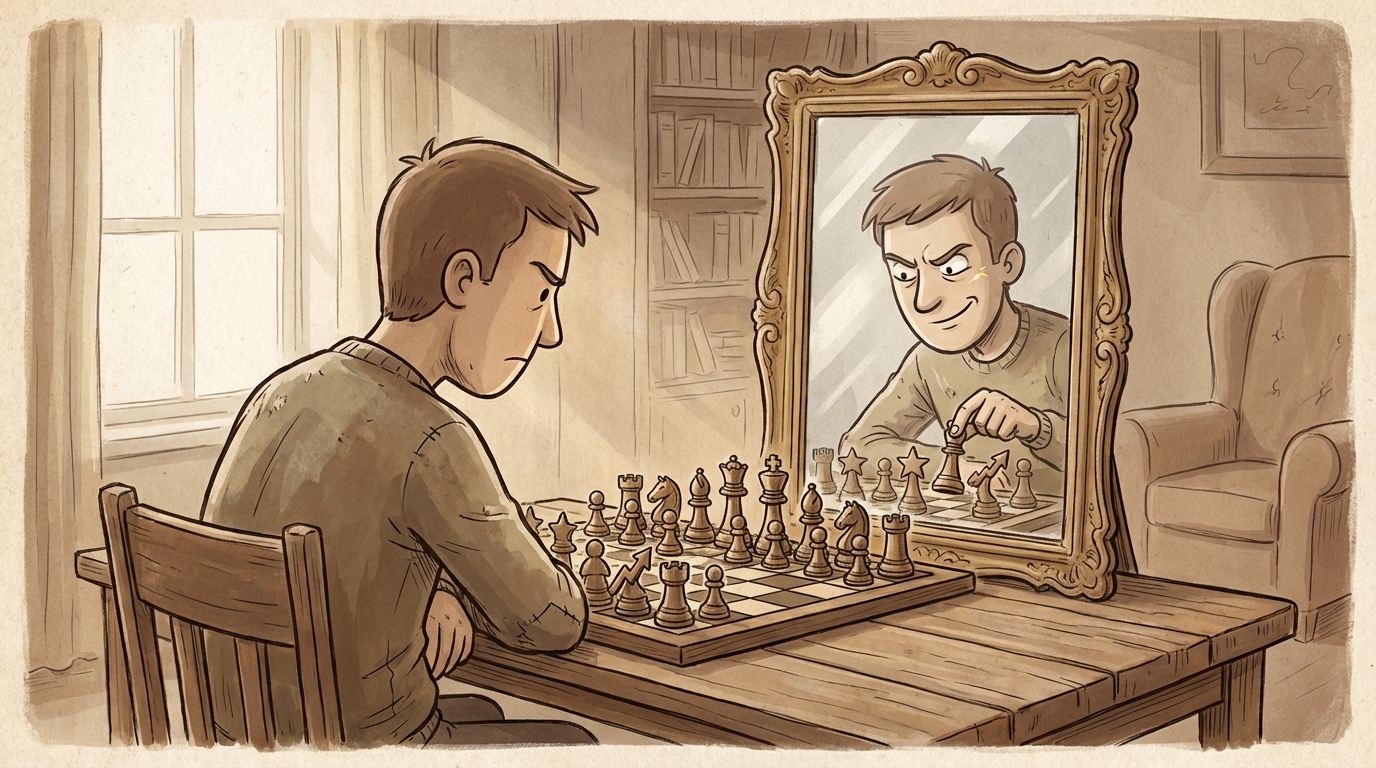
Imagine your biggest competitor secretly hiring you as a consultant.
Your job? Give them the exact playbook to take your business down.
What’s the first thing you’d tell them to do?
If that question makes you uncomfortable—it should.
Because somewhere in your answer lies your biggest vulnerability. And your competitors are actively looking for it.
You Want to Be Netflix, Not Blockbuster
Blockbuster ignored digital transformation.
They doubled down on what worked instead of adapting to what’s next.
Netflix exploited this by offering convenience, no late fees, and on-demand access.
We all know how that ended.
The same thing happens in business every day. Just smaller, quieter, less dramatic. But equally fatal.
A competitor notices you’re weak on customer support. They build their entire positioning around responsiveness.
A competitor sees your pricing is complex. They launch with radical simplicity.
A competitor realizes your product is powerful but hard to use. They build something less powerful that’s dead simple.
They don’t beat you by being better at everything. They beat you by being better at the one thing you’re ignoring.
We’re Wired to Ignore Weaknesses
Humans are naturally drawn to their strengths.
Doubling down if it works, right?
You built a great product. You focus on making it greater. You invest in features, performance, scalability. You’re playing to win.
Meanwhile, your competitor isn’t trying to out-product you.
They’re studying what you’re not good at. What you’re not paying attention to. What you’ve decided isn’t important.
And they’re building their entire strategy around that gap.
By the time you notice, they’re not just catching up. They’re taking over.
The Thought Experiment That Reveals Everything
Here’s what makes this exercise so uncomfortable.
When you force yourself to think like a ruthless competitor, you immediately see things you’ve been rationalizing away.
“Our onboarding could be better, but it’s functional.”
A competitor hears: “Their customers struggle for the first three days. We can win them in the first three minutes.”
“We don’t have 24/7 support, but our customers are mostly in one timezone.”
A competitor hears: “Emergency at 9pm on a Saturday? They’re on their own. We’ll be there.”
“Our pricing is complex because our product is sophisticated.”
A competitor hears: “Prospects bounce when they see our pricing page. We’ll put one number front and center.”
You thought these were acceptable trade-offs. Your competitors see them as attack vectors.
How to Find Your Weaknesses Before They Do
Want to spot your biggest vulnerabilities before your competitors exploit them?
Step 1: Pretend you’re a ruthless competitor starting from scratch.
You have no existing product, no legacy customers, no technical debt. You can build exactly what the market needs without any constraints.
What would you build to steal your own customers?
Step 2: Identify what you’d attack.
Is it pricing? User experience? Customer service? Speed? Simplicity? Support? Positioning?
Don’t rationalize. Don’t defend. Just identify the gaps.
If you were competing against yourself, where would you focus all your energy?
Step 3: Fix it before someone else does.
Not everything on that list is worth fixing. Some trade-offs are intentional and smart.
But the gaps that make you uncomfortable? The weaknesses you’ve been telling yourself “aren’t that bad”?
Those are the ones your competitors are betting on.
The AI Prompt That Makes This Real
Here’s a prompt I use with clients to surface blind spots:
I want to conduct a strategic business audit from the perspective
of my biggest competitor.

Act as a ruthless competitor who is analyzing my business with
the intent of taking my customers and outcompeting me.

Ask me 10 deep-dive questions to uncover potential weaknesses,
blind spots, or missed opportunities in my business.

Once I answer, provide me with a detailed competitor strategy
that exploits these weaknesses.

Then, help me craft an action plan to defend and strengthen
my business against these threats.
Run this exercise. Answer honestly. Then look at what comes back.
Some of it will be wrong. Some will be strategies you’ve already considered and rejected.
But some of it will hit hard. Because it will surface the thing you’ve been avoiding.
What Actually Happens When You Do This
I’ve run this exercise with clients who thought they knew their business inside out.
Every single time, something surfaces that makes them uncomfortable.
“We’ve been telling ourselves our complex pricing reflects our value. But really, it’s just confusing and we’ve been too close to it to see that clearly.”
“We keep saying our UI is ‘powerful’ when what we mean is ‘complicated.’ A competitor could build something half as powerful that’s three times as easy and win.”
“Our customer support is great once you get through. But getting through takes 48 hours. We’re vulnerable to anyone who just picks up the phone.”
These aren’t revelations about bad products. They’re revelations about blind spots.
The gaps between what you think your positioning is and what the market actually experiences.
When Ignoring Weaknesses Becomes Strategy
Some weaknesses aren’t worth fixing.
If you’re building enterprise software, no competitor is going to beat you by being cheaper. Your customers pay for reliability and support, not low prices.
If you’re building a premium tool, no competitor is going to beat you by being simpler. Your customers want power, not hand-holding.
The question isn’t “do I have weaknesses?” Everyone does.
The question is: “Do I know which weaknesses matter to the customers I’m trying to keep?”
If you’re losing deals and you don’t know why, run this exercise. The answer is usually hiding in the gap between your strengths and their expectations.
Frequently Asked Questions
Won’t focusing on weaknesses distract from our core strengths?
Not if you’re strategic about which weaknesses matter. Some gaps are fine to leave. But the ones costing you customers? Those need attention, even if fixing them isn’t as exciting as building new features.
What if our competitor is already doing this to us?
Then you’re already behind. But you can still catch up. Most competitors don’t execute perfectly. If you move quickly to shore up genuine vulnerabilities, you can neutralize their advantage before it becomes insurmountable.
How do I know which weaknesses to prioritize?
Listen to why deals fall through. Read lost customer interviews. Check what competitors emphasize in their positioning. If they’re talking about speed and you’re not, that’s probably where you’re weak.
Isn’t this just playing defense instead of building something great?
Playing defense is only a problem if that’s all you do. But ignoring obvious vulnerabilities isn’t strategy—it’s denial. The best companies play offense and defense. They build new things while protecting what they already have.
What if we’re too small to worry about competitors yet?
You’re never too small to think about positioning. Even if you don’t have direct competitors today, you’re competing against inaction. What would make someone choose your solution over doing nothing? That’s the gap you need to close.
Key Takeaways
- Competitors don’t attack your strengths: They study your weaknesses and build entire strategies around exploiting them before you notice.
- Blind spots cost deals: The gaps you’ve rationalized as “good enough” are often exactly where customers are choosing someone else.
- Find vulnerabilities before they do: Run the competitor thought experiment, identify real weaknesses, and fix the ones that matter before they become your Blockbuster moment.
If your biggest competitor hired you as a consultant, what’s the first thing you’d tell them to do? Reply and let me know—I’ll feature the most insightful responses in my next post.
Ohad Michaeli
Strategic positioning for Shopify apps
Want more insights like this?
Join Shopify app founders who get actionable positioning and optimization strategies.