Stop Discounting Blindly: Why Mystery Gifts Beat 30% Off
Blanket discounts destroy margins. Strategic promotions move inventory while protecting profit. Here's how smart merchants do it.
TL;DR
Merchants running blanket discounts lose more money than necessary while training customers to wait for sales. Strategic promotions using excess inventory, bundling, and mystery gifts create excitement without destroying margins. The math: losing $5 in inventory costs beats losing $60 in discount margin every time.
Who This Is For
Shopify merchants and e-commerce founders who default to percentage discounts for every promotion, especially those sitting on excess inventory or struggling with thin margins.
The Core Problem
You’re running a 30% off sale because that’s what gets attention, but you’re losing more money per order than you need to while training your customers to never buy at full price.
I was reviewing a Shopify merchant’s promotion strategy. They were planning another 30% off sale.
On a $200 average order, that’s $60 per transaction they’re giving away.
I asked what they were trying to accomplish. Clear inventory? Drive revenue? Acquire customers?
“Just need to hit this month’s number.”
That’s when blanket discounting becomes a habit instead of a strategy.
The Real Cost of Discounts
A 30% discount feels straightforward. Everyone understands it. It’s easy to communicate. It definitely drives sales.
But look at the math.
If your product costs $100 to make and deliver, and you sell it for $200, your margin is $100.
Give a 30% discount and your margin drops to $40. You’re keeping less than half your original profit while doing the same work.
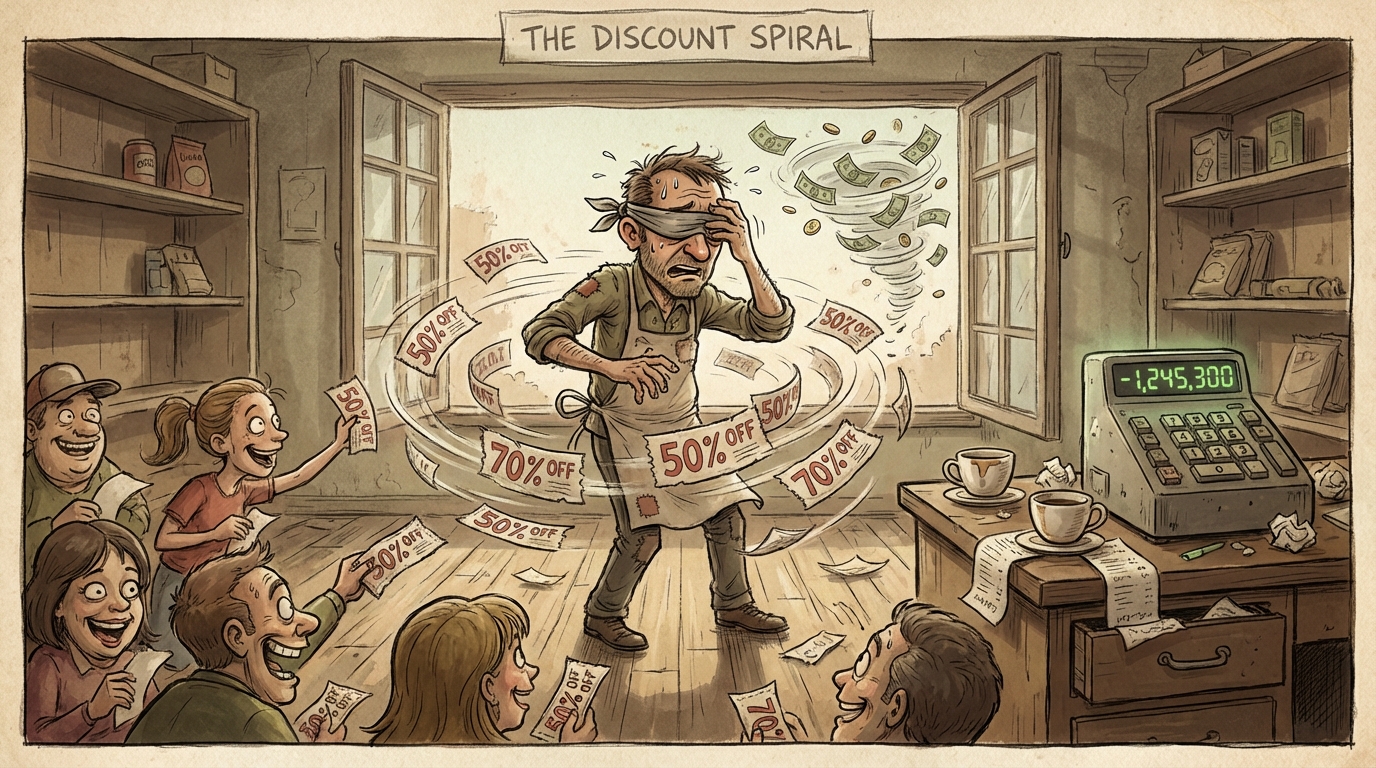
Run this promotion often enough and customers stop buying at full price. They learn to wait. Your baseline revenue drops because everyone expects a sale.
Now you’re in a cycle. Need revenue? Run a sale. Customers wait? Run a bigger sale. Margins shrink. The business gets harder.
The Inventory Opportunity
Most merchants sitting on excess inventory don’t think of it as a promotional asset. They think of it as a problem.
Slow-moving stock. Products that didn’t sell. Seasonal items past their peak. Overstock from a miscalculation.
These items are sunk costs. You already paid for them. They’re taking up space. The question is how to move them without destroying your margins on everything else.
Blanket discounts solve this by making everything cheaper. But that’s overkill. You don’t need to discount your bestsellers to move slow inventory.
The Alternative Approach
Instead of 30% off everything, offer a mystery gift with purchase.
Customer buys at full price. You add something from your excess inventory. Let’s say it cost you $5 and they have no idea what it is until it arrives.
You protected your margin. You moved inventory. You created an experience that feels special instead of transactional.
The mystery part matters. Getting 30% off is expected. Getting a surprise gift feels like winning something.
This came up in an app audit. The founder said: “Instead of losing $60, here’s a scarf from inventory that might cost $5 - and people love a mysterious gift!”
The customer gets something extra. The merchant moves inventory at minimal cost. Everyone wins.
Why This Works
Discounts are about saving money. Gifts are about getting something extra.
These hit different psychological triggers.
When you discount, you’re teaching customers to focus on price. They’re comparing your sale to your competitors’ sales. They’re calculating value in dollars saved.
When you add a gift, you’re creating a bonus. Something they didn’t expect. They’re not comparing it to anything because they don’t know what it is yet.
The surprise element adds perceived value beyond the actual cost. A $5 item in a mystery gift feels more valuable than $5 off the price.
Strategic Bundling
Another approach: bundle slow inventory with bestsellers.
Customer wants product A. You offer a deal: buy product A, get product B at half price.
Product B is something you’re trying to move. But positioning it as an add-on to a full-price purchase protects your main margin while clearing inventory.
This works better than discounting both products because the customer came for product A. They’re buying at full price. Product B is an impulse addition, not the main purchase.
You moved two items. You maintained margin on the one that matters. You cleared inventory on the one that doesn’t.
Context-Aware Promotions
Smart merchants tie promotions to actual conditions instead of running generic sales.
Weather-triggered promotions work. If it’s raining in your customer’s city, offer rain gear at a small discount or as an add-on. You’re solving an immediate problem with relevant inventory.
Event-based promotions work. Local team wins? Offer team colors. Holiday coming up? Bundle related items.
Inventory-based promotions work. Getting low on something? Create urgency with “only 10 left” messaging. Overstocked on something? Create mystery bundles that include it.
These feel specific and timely instead of desperate and generic.
The Margin Protection Framework
Before running any promotion, ask:
- What am I trying to accomplish?
- Do I need to discount bestsellers to achieve it?
- Can I use excess inventory as the incentive instead?
- What’s the actual cost difference between discount and gift?
Most of the time, there’s a cheaper way than blanket discounting.
Free shipping with minimum purchase moves inventory while protecting margins. Mystery gifts add excitement at low cost. Strategic bundling clears slow products without training price sensitivity.
The only time blanket discounts make sense is when you’re specifically trying to train customers on pricing. New store? Prove value with an initial discount. That’s strategic.
But ongoing promotions should protect your margins while still creating urgency.
The Customer Psychology
Customers don’t actually want deep discounts. They want to feel like they got value.
Value can come from:
- Paying less (discounts)
- Getting more (gifts, bonuses)
- Exclusive access (early release, limited items)
- Solving immediate problems (weather, events, timing)
Merchants default to discounts because they’re easy. But the other approaches often work better while costing less.
A customer who gets a mystery gift tells friends about it. A customer who bought during your 30% off sale… doesn’t. One is an experience. The other is expected.
How to Actually Implement This
Start by identifying excess inventory. What’s been sitting too long? What overstocked? What’s seasonal but past peak?
This is your promotional currency. Instead of discounting to move it, use it as value-adds for full-price purchases.
Create tiers: spend $100, get mystery item A. Spend $200, get mystery items A and B.
Or bundle: buy this bestseller, add this slow mover for 50% off.
Or contextualize: rain forecast? Free umbrella with purchase while supplies last.
Track the costs. Mystery gift that costs you $5 is better than $20 discount if it drives the same conversion. Even if the perceived value is lower, your margin says it’s smarter.
The Long-Term Effect
Customers trained on discounts become discount-dependent. They wait for sales. They don’t value your full-price products.
Customers who associate your brand with bonuses and surprises develop different expectations. They’re buying for the product, and the extras are treats.
One relationship is about price. The other is about experience.
Which business would you rather run?
The App Store Angle
If you’re a Shopify merchant, there are apps that help with this. Smart promotion tools, inventory-based gifting, weather-triggered offers.
The implementation is easy. The hard part is shifting your mental model from “we need revenue, run a sale” to “we need revenue, what’s the smartest promotion?”
That shift is worth thousands in preserved margin.
Frequently Asked Questions
Won’t customers be disappointed if the mystery gift is something they don’t want?
Sometimes, but the cost is minimal and the upside is worth it. Set expectations clearly: “mystery bonus gift with purchase” signals it’s extra, not the main value. Most customers treat it as a fun surprise rather than a promised benefit. And some will love it enough to post about it, which is marketing you couldn’t buy for $5.
How do I know what inventory to use for these promotions?
Start with items that have been sitting for 90+ days, seasonal items past peak, or products you overstocked. Anything with low turn rate where the carrying cost exceeds the promotional cost. You’re not trying to move premium inventory this way. You’re clearing space and cost while adding perceived value to full-price purchases.
What if I’ve already trained my customers to expect discounts?
You can retrain them, but it takes time. Start mixing in non-discount promotions alongside discounts. “This week: mystery gift instead of % off.” Track which drives better margin per order. Gradually shift the mix. Some customers will leave. The ones who stay are the ones who value your products, not just your sales.
Do mystery gifts work for all product categories?
They work best for categories where discovery is part of the appeal: fashion, beauty, home goods, accessories. They work less well for purely functional purchases where customers know exactly what they need. But strategic bundling works across all categories. Match the approach to what makes sense for your products.
How often should I run these promotions versus traditional discounts?
There’s no magic ratio, but if you’re running discounts more than quarterly, you’re probably training price sensitivity. Reserve deep discounts for specific strategic moments: clearing seasonal inventory, customer acquisition campaigns, genuine holiday events. Use lower-cost promotions (gifts, bundling, contextual offers) for ongoing sales drives. Protect your full-price business.
Key Takeaways
-
Mystery gifts protect margins better than discounts: A $5 inventory item as a bonus preserves more profit than a 30% discount while creating surprise and delight that customers actually remember.
-
Context-aware promotions outperform blanket sales: Weather-based, event-triggered, or inventory-driven offers feel timely and relevant rather than desperate, moving products without training customers to wait for sales.
-
Excess inventory is promotional currency: Slow-moving stock you’ve already paid for costs almost nothing to give away as bonuses, making it more valuable as a marketing tool than sitting in storage or getting deeply discounted.
Blanket discounts are the lazy default. They work, but they’re expensive and they train the wrong customer behavior.
Strategic promotions take more thought, but they’re cheaper and more effective.
Look at your excess inventory. Look at your typical promotion costs. Do the math.
Giving away $5 items beats discounting $60 every single time.
And the customers who get surprised by a mystery gift? They remember that. They tell people. They come back.
The customers who bought during your 30% off sale? They’re waiting for the next one.
Which customer base would you rather build?
Ohad Michaeli
Strategic positioning for Shopify apps
Want more insights like this?
Join Shopify app founders who get actionable positioning and optimization strategies.