Shopify's Review Policy 1.3: What Changed, and What to Do If You Lost Reviews
Shopify now unpublishes app reviews it can't verify as trustworthy under Policy 1.3, effective July 6, 2026. What triggers it, what a real removal case looked like, and how to build reviews that never get caught in it.
TL;DR
Shopify updated App Store Policy 1.3, “Always use honest and transparent review practices,” effective July 6, 2026. It clarifies enforcement of an existing rule in the Partner Program Agreement (Section C.2.1) and adds a new publishing filter: reviews that don’t meet Shopify’s trust standards get unpublished, sometimes automatically, and can reappear later if they meet the standard on a later pass. Named consequences for violations include removal of a portion of your reviews, demotion or delisting, and termination of your Partner account. If your review count drops without warning, check first whether your request flow matches the pattern this policy is built to catch. A faster review-request campaign won’t fix that, and it can make the next removal bigger.
Who This Is For
Shopify app founders who saw their review count drop after July 2026, or who run review-request flows and want to know if they’re exposed before Shopify flags them.
The Core Problem
Shopify can now unpublish App Store reviews it can’t verify as trustworthy, and founders who built their review count through incentivized or batched request flows are finding out about the policy only after the reviews are already gone.
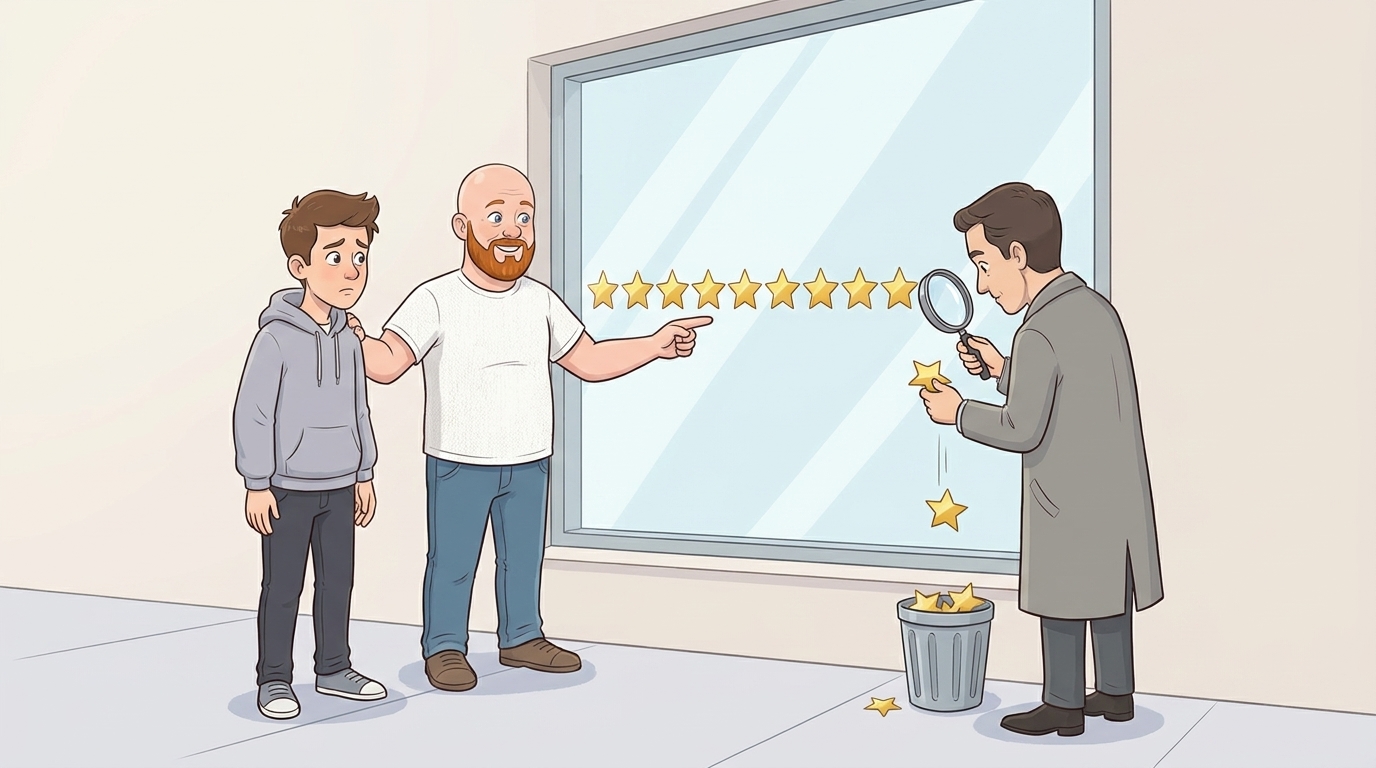
A “review policy update” in the changelog is easy to skip past. This one is worth stopping on, because it isn’t a wording tweak. Shopify changed what happens to a review the moment it can’t confirm the review is trustworthy: it doesn’t stay up by default anymore. It gets held back.
That’s a real shift in how the App Store treats social proof, and it landed with enforcement teeth attached. A developer on Shopify’s own community forum reported waking up to almost all of their five-star reviews gone, a few days after the policy took effect. That case is real, it’s documented, and it’s worth understanding in detail before you decide whether your own review practices are exposed.
What Is Shopify App Store Policy 1.3?
Policy 1.3, “Always use honest and transparent review practices,” is part of Shopify’s App Store requirements. Shopify published an update to it effective July 6, 2026. The update doesn’t introduce a brand-new rule out of nowhere. It clarifies how Shopify enforces an existing obligation already sitting in the Partner Program Agreement, Section C.2.1, which covers reviews on the Shopify App Store.
Alongside the clarification, Shopify changed the mechanics of what gets published. In its own words, only reviews that meet its trust standards will appear publicly. Reviews that don’t meet that standard get unpublished, and can be published automatically later if they end up meeting the standard on a subsequent check.
That second part changes what a review count actually means. Review visibility on your listing isn’t a one-time event anymore. A review that goes up today can come down next week if Shopify’s trust check changes its read on it, and it can come back later if the check changes again. Shopify now re-evaluates your review count continuously, against a standard it hasn’t published in detail.
Why Did Shopify Remove My App’s Reviews?
If your review count dropped after July 2026, the most direct explanation is that the reviews you lost didn’t pass Shopify’s trust check under the new publishing logic, not that Shopify made an arbitrary cut.
A concrete case shows what this looks like in practice. A developer filed a report on the Shopify community forum on July 9, 2026, three days after the policy took effect. Their account: roughly 185 reviews, almost all of them five stars, disappeared from their listing at once. By their own description, they had a review-request flow that Shopify had already flagged as non-compliant, they changed the flow after that warning, and the mass removal happened anyway, afterward.
The developer disputes that the removal was fully justified given they’d already corrected the flagged behavior, and they’ve asked Shopify for a manual review. That dispute is theirs, not a verdict either way on whether Shopify was right to remove that specific batch. What the case does establish, independent of who’s right, is the shape of what triggered it: a review-request pattern Shopify had already flagged once, tied to a large cluster of reviews that came down together.
There’s no public aggregate count of how many reviews Shopify has removed industry-wide since July 6. Anyone telling you an overall number is guessing. What’s verifiable is the mechanism and one documented case that shows it in action.
What Triggers a Review Removal Under Policy 1.3?
Shopify hasn’t published the exact trust-check criteria, and it would be a mistake to pretend otherwise. But the policy’s own language, “honest and transparent review practices,” combined with the case above, points at a specific failure mode: review-request flows built to produce reviews in bulk rather than one at a time from genuine use.
If a review-request pattern generates a cluster of reviews that arrive together, look similar, and trace back to an incentive or a batch prompt rather than an individual merchant’s independent decision to leave feedback, then that cluster is exactly what a trust-and-authenticity check is designed to catch, because clustering is the signature a real usage pattern doesn’t produce.
Real reviews, earned one merchant at a time from actual use of the app, don’t arrive in that shape. They come in at uneven intervals, from merchants who found the app on their own timeline, phrased in whatever language that merchant happened to use. A fake-review scheme or an incentivized batch request produces the opposite: reviews that cluster in time, tone, and rating. That clustering is a pattern, and enforcement systems are built to find patterns.
What Happens If Shopify Flags My Review Practices?
Shopify names three consequences directly in the policy: removal of a portion of your reviews, demotion or delisting of your app, and termination of your Partner account. Those aren’t listed as alternatives you might get one of. They read as an escalation path, starting with a review cut and ending, in the worst case, with losing your Partner account entirely.
That escalation logic changes how you should treat a first warning. If Shopify has already flagged your review-request flow once, then correcting the flow going forward isn’t the end of the exposure, because the reviews already generated under the old flow can still be evaluated and removed under the new trust check, independent of the fact that you’ve since fixed the process producing them.
This is the detail that made the community case sting the way it did. The developer’s account is that they fixed the flow after Shopify’s first flag, and the removal happened anyway. Whether or not Shopify’s specific judgment call in that case was correct, the general lesson holds regardless: a policy that can retroactively unpublish reviews means “we already fixed it” doesn’t automatically clear reviews generated before the fix.
Should You Replace Removed Reviews by Requesting More, Faster?
No. If a batch-style request pattern is what got flagged in the first place, then running another batch request to replace what got removed reproduces the exact signature the trust check is built to catch, and you risk a second, larger removal on top of the first.
I’ve spent years telling founders that review count is the wrong number to optimize for, and this enforcement pass is the clearest evidence yet for why. A review count built from real usage, one merchant leaving one honest review after actually using the app, doesn’t cluster unnaturally and doesn’t disappear in an enforcement sweep. A review count built from a fake-review scheme or a coordinated, incentivized request campaign is precisely what clusters, and clustering is what this kind of policy exists to find.
There’s a second reason to stop chasing raw count, and it has nothing to do with enforcement risk. In my own observation of listings over the years, what actually reads well to a merchant scanning your listing is how recently reviews have been landing, not your total star count or review count. A merchant giving your listing its typical few minutes of attention notices a stale rating with no recent activity differently than a lower rating that’s still moving. To be precise about what this claim is and isn’t: Shopify hasn’t published what its ranking algorithm weighs, and no outside party has proven that review recency is a ranking factor. This is about what a merchant perceives reading your listing, not a claim about how Shopify’s algorithm scores you.
Either way, the fix points the same direction. Build a request flow that produces reviews steadily and naturally, tied to real usage moments, rather than in bursts tied to a campaign. That’s both what the policy is built to allow and what reads better to the merchant deciding whether to install.
What Does Honest Review Generation Actually Look Like?
Ask for a review at a moment the merchant actually experienced value from your app, not at a fixed time interval or in response to an incentive. A merchant who just recovered a cart, hit a milestone, or solved a specific problem with your app is leaving a review because something real happened, not because a prompt or a reward pushed them to.
Space requests out across your install base instead of triggering them all from the same event or the same day. If your app has been live for a while and you haven’t been asking for reviews consistently, the instinct to catch up all at once is exactly the instinct that produces a batch pattern. Slower and steadier beats a sprint here.
Never tie a discount, credit, or feature unlock to leaving a review. That’s an incentive, and incentivized reviews are a named failure mode under honest-review requirements, not a gray area.
Let the review reflect the merchant’s actual words. Don’t supply a template they’re expected to copy, and don’t pre-fill star ratings. A review flow that guides content toward a specific script is closer to manufacturing feedback than collecting it.
If you’re not sure whether your current flow reads as batch-shaped from the outside, that’s worth checking before Shopify checks it for you. Reviews carry more positioning signal than their star count suggests when they’re genuine, and that signal is worth protecting rather than diluting with volume you can’t defend.
This also isn’t the first time Shopify has removed reviews from listings at scale. An earlier incident pulled reviews for different reasons, described at the time as a data-quality cleanup rather than a trust-and-authenticity enforcement action. The two events aren’t the same mechanism and shouldn’t be read as one continuing story, but together they say the same thing twice: review count on the App Store has never been as stable as it looks on your listing page.
How Do You Fix Your Review Strategy After a Removal?
Start by auditing your own review-request flow against the incentive and batching questions above, before Shopify’s trust check does it for you. If you find anything that looks close to the pattern in the community case, fix the flow now rather than waiting for a flag.
Expect this to take longer than a quick fix. A review flow that produces steady, natural reviews from real usage moments builds up over months, not days. That’s slower than a batch campaign, and it’s also the only version of review growth that survives an enforcement pass like this one.
If you’ve already lost reviews and believe the removal was a mistake, Shopify’s own forum shows a manual review request is the available path, not a guarantee. Build your case around specifics: when the reviews were generated, what your request flow looked like at the time, and what you’ve changed since.
Frequently Asked Questions
Why did Shopify remove my app’s reviews?
The most likely explanation is that the removed reviews didn’t meet Shopify’s trust standards under the updated publishing logic in Policy 1.3, effective July 6, 2026. Shopify’s own language says only reviews meeting its trust standards stay published, and reviews that don’t meet it get unpublished, sometimes automatically. A review-request flow that produces clustered, batch-like, or incentivized reviews is the pattern most likely to trigger this.
What is Shopify App Store Policy 1.3?
Policy 1.3, “Always use honest and transparent review practices,” is a Shopify App Store requirement clarifying enforcement of Section C.2.1 of the Partner Program Agreement, which covers reviews. Shopify updated its enforcement of this policy effective July 6, 2026, adding a trust-based publishing filter on top of the existing rule.
Can removed reviews come back on my Shopify listing?
Yes, according to Shopify’s own description of the mechanism. Reviews that don’t meet the trust standard when checked can be published automatically later if they meet the standard on a subsequent evaluation. That means review visibility under this policy is an ongoing check, not a one-time decision.
What happens if Shopify flags my app for review policy violations?
Shopify names three possible consequences: removal of a portion of your reviews, demotion or delisting of your app, and termination of your Partner account. These read as an escalation path rather than isolated options, so a first flag is worth treating as a warning about exposure that continues even after you fix the underlying flow.
Should I ask for more reviews to make up for the ones I lost?
Not through the same kind of flow that got you flagged. If a batch or incentivized request pattern caused the original removal, repeating that pattern to replace lost reviews risks a second, larger removal. Build a slower, steadier request flow tied to real usage moments instead.
Key Takeaways
- Shopify’s Policy 1.3 update, effective July 6, 2026, added a trust-based publishing filter: reviews that don’t meet the standard get unpublished and may be republished automatically later if they pass a later check.
- A documented community case shows roughly 185 reviews removed at once, days after the policy took effect, following a review-request flow Shopify had already flagged, per the developer’s own account on Shopify’s community forum.
- The named consequences escalate: removal of a portion of reviews, then demotion or delisting, then Partner account termination.
- Fixing a flagged request flow doesn’t retroactively clear reviews generated under the old flow, because the trust check can re-evaluate reviews after the fact.
- Review recency reads better to a merchant scanning a listing than total star count, based on what merchants perceive during their brief look at a listing, not a proven claim about Shopify’s ranking algorithm.
If you’re not sure whether your review-request flow would hold up under this kind of check, a Shopify app audit is a fast way to find out before Shopify tells you the hard way.
Ohad Michaeli
Strategic positioning for Shopify apps
Want more insights like this?
Join Shopify app founders who get actionable positioning and optimization strategies.